Tuesday, September 3, 2013

Jerusalem Part 2

More reflections from our trip to Israel in 2010. Jerusalem quickly became my favorite place to travel.  Here are some more memories from our time in the Holy City.

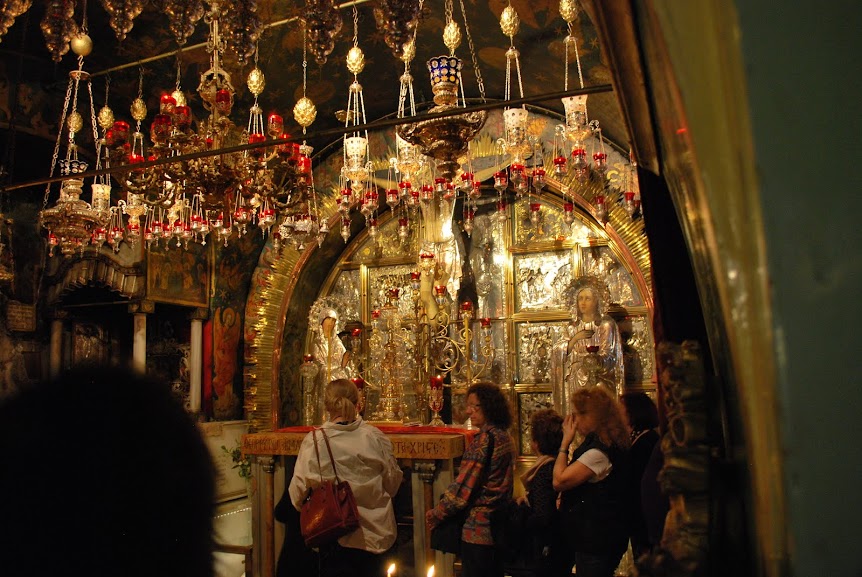
Monday was a free day for us to do whatever we desired.  We caught a couple of cabs and headed in to Jerusalem – we were there by 8 am.  The streets of the Old Town were being washed down by the merchants, and the streets were very abandoned.  We headed back to the Church of the Holy Sepulchre, and we are so glad that we did – there were few people in the church (even though it opens at 4:30 am), and we were able to take our time at the place of the cross and the place where Jesus was prepared for burial.  Again, who knows for sure where this might have taken place, but it is so moving to be able to take time to really focus on these events we will soon remember the next few days in our churches.  As our Catholic member of the group mentioned, the Stations of the Cross are so scripted on Good Friday, we methodically work our way through them, but here, we have time to focus and pray at each place.


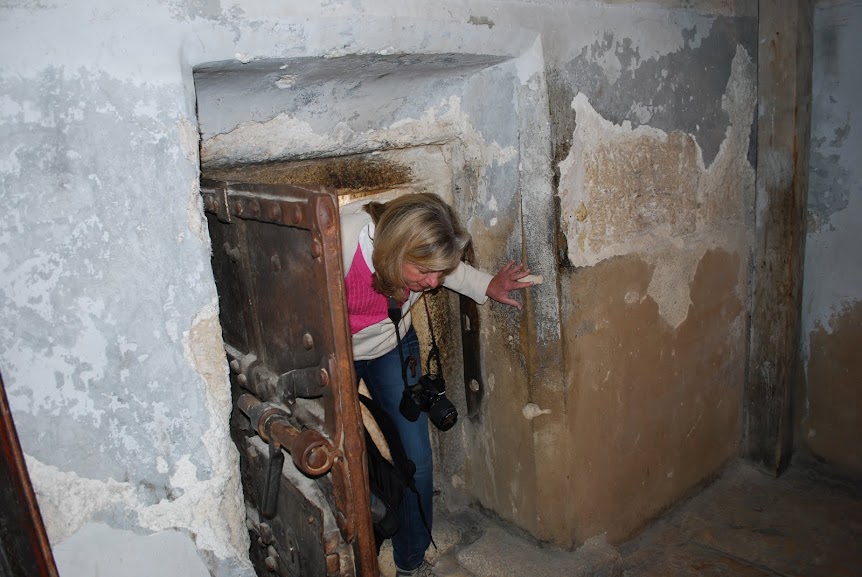
We took time to admire the incredible artwork and mosaics in the church, then got in line to go in to the place of the tomb itself.  The line yesterday was some 3 hours long.  Today we stood in line less than a half hour.  The stone walls surrounding that spot limit the number who can fit, so it takes a while to get in – only three or four at a time.  It was so nice not to be rushed.  It was a very meaningful event for all of us.
We headed out of the church and around the corner to the Lutheran Church of Holy Redeemer.  The church is very nice – simply decorated, and lovely structure – built by Kaiser Wilhelm II in the 1800s.  We then journeyed up the spiral staircases (major climb of the day) to the top of the spire of the church.  From here we could see the city in all its splendor.  Because God blessed us with another cloudless day, we were able to get some incredible photos.


Once back down to the street level, we took our luck at bartering in the market place.  It was fun when Lisa was bartering for a dress, and in the process told the man that it was her birthday.  He offered her a blessing that he hoped she would live for 100 years.  In his broken English, Lisa thought he said that he thought she WAS 100 years old.  He almost lost the sale!


The other fun store was the man who was going out of business, so everything was on sale!  Tom and Bruce did very well with their bartering.  I spent time taking pictures (much safer for me!).  We all bought something, including some delicious honey-roasted nuts with sesame seeds on them.  They were great!  We also got some fresh squeezed orange juice at one shop that was wonderful.
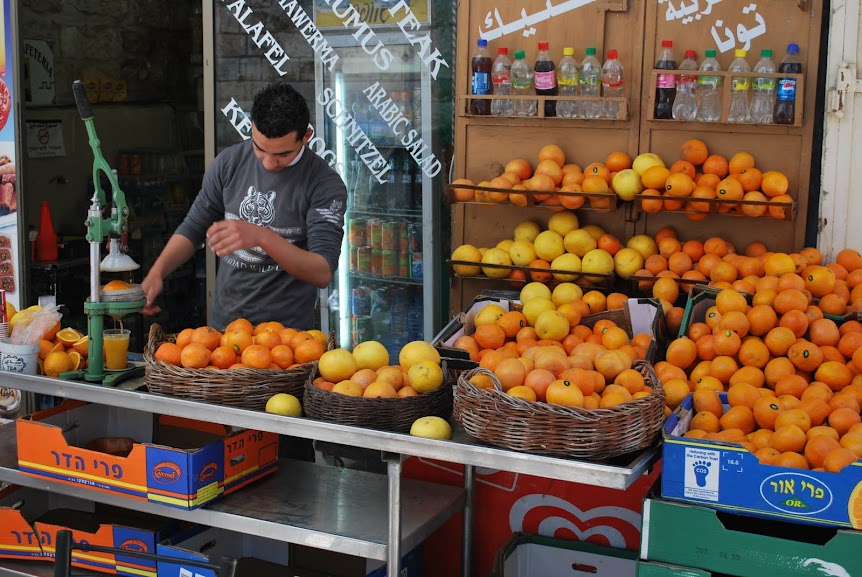

We stopped at a few other stations of the cross, and worked our way down some streets, including the Muslim Quarter – we were the only Americans around… definitely a market place.  Spices, fresh produce, toy stores, shoe makers, you name it.  Lots of mothers and children out shopping.  We walked up one street and watched a couple of young men riding a cart downhill with fresh produce, hopefully stopping before the end of the street.


We had lunch at a small pizzeria in town, which wasn’t half bad.  We watched a couple of tour groups come and go as we ate our lunch.  After that, it was time to move on to the next stop of the day, the Yad VaShem Holocaust Museum.  This beautiful structure is free of charge, and an excellent historical site.  The museum is housed in a long, A-framed building, winding you back and forth from one leg of the A to the other.  It begins with the anti-Semitic acts and attitudes of the early 1900s, and carries you through the Ghettos, the Work Camps, the Concentration Camps and the Death Marches, and finally ends with the founding of the country of Israel.  The last room you enter is some 30 feet tall, maybe taller, a circular room with volumes of books on the shelves listing information about 3 million verified names (some say that the complete number is as many as 6 – 7 million) of people murdered in the Holocaust.  That was powerfully moving.


The exit of the museum leads you out to a breathtaking view of Israel – a reminder of the hope of the nation and the land.  We then walked through the Children’s Museum, given in honor of the son one couple lost in the Holocaust.  A garden surrounds a statue in honor of Gentiles who saved or helped hide or rescued survivors.   A final building is in honor of the children – you enter a dark hallway with lights flickering above – as you walk around the mirrored walls reflecting these points of light, names and ages of the murdered children are read.  It was a weighty experience, but so meaningful, and to walk through as young men and women in military school uniforms are there as well, and in the land of Israel – it made it all the more so powerful.

We ventured back to the hotel, then headed out tonight for Chinese – we walked 10 minutes to the Yo-Si Peking Diner – located above the grocery store down the street from our hotel.  We entered, and it was deserted.  The place had come highly recommended by a desk clerk at the hotel, but we started out fairly doubtful.  Even worse, the waitress didn’t speak much English.  So here we are, Americans in a Chinese restaurant not knowing a lick of Hebrew in Jerusalem.  BUT, things got much better fast!  We ordered drinks and meals, and the feast began – soup (corn, wanton, hot and sour), deliciously fresh egg rolls, then the main dish – orders of sweet and sour chicken, almond chicken, beef and peppers, Thai chicken, and rice and noodles.  Fantastic meal, and more than enough to eat!  The waitress understood us enough when we told her it Lisa’s birthday, so dessert came with sparklers on it.  Dessert included fried bananas and pineapples, leeche, watermelon and cantaloupe and sherbet.


Our last day of touring began with a trip to the Mount of Olives for an incredible view of Jerusalem.  Hundreds, maybe thousands of tour buses are there every day, and I was wondering if it would be difficult to get a shot.  Not a problem – the view is incredible.  We got a group shot with most of our tour group, a group shot of our 7 together with our tour guide and bus driver.


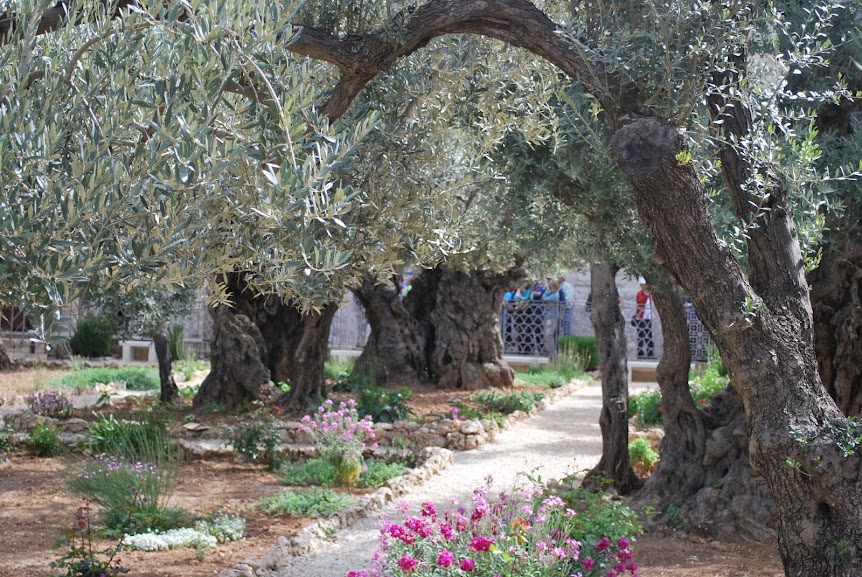
When done there, we drove to the Garden of Gethsemane, and were guided to a private part of the garden, where we were given time to pray among the old olive trees and flowers.  It was very moving to be in that place.   In the midst of the garden, Lisa found a turtle rustling in the leaves.  Of course, I got pictures of that as well.   On the grounds of the Garden is a beautiful church called the Church of All Nations or the Church of the Agony.  Inside are domes dedicated by different countries, including the United States.  In front of the altar is a rock  believed to be where Jesus prayed for the cup of suffering to pass from him, but not HIS will, but His Father’s will be done.  There are three paintings that adorn the front of the church, depicting the night of Jesus’ betrayal.


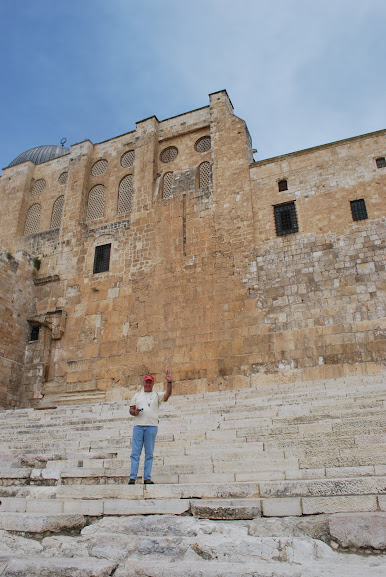
Out to the bus again to travel to the Archeological Park at the southwestern corner of the Temple in Jesus’ day.  The time spent walking on the ground around the Temple where Jesus and the disciples walked was very cool.  The museum had a video that depicted a pilgrim coming to the Temple, paying the taxes, buying the animal for sacrifice, washing in the purifying baths, and coming to worship at the Temple Mount.  I really enjoyed this visit at the Temple – at this point of the trip, all the pieces of the city came together for me.
A few things of note that I learned today (maybe I should have paid closer attention in Seminary):

  • The ritual baths were located outside the walls of the city – a ritual cleansing/bath – you go down one side of the steps into the bath, and up the other side, so as to remain pure for worship in the Temple.
  • The steps outside the Temple varied in depth, so some steps you had to take one step, others you had to take two steps – the reasoning behind this was to make sure you didn’t rush up the steps, but instead focused on the reverence of entering the holy place.
  • To enter the Temple area, one gate would be for entering and another for exiting.  If you were mourning the loss of a loved one, you would go through the opposite gate, so that fellow worshipers would be mindful of you and bless you.


Throughout the trip, I was aware of the fact that excavation and discovery continue throughout the city of Jerusalem and across the country.  Some of the museums are very new, and some have expansion efforts going on.  I am sure that the next time we come, there will be even more to see.
We went to the Ramat Rachel Kibbutz for lunch (a kibbutz is a collective farm or settlement owned by its members in modern Israel.  There are schools and markets and centers for the people).  It was a beautiful setting, and we ate our final lunch outside enjoying the lovely weather.
After lunch, we drove by some of the government buildings, including the Israel version of the IRS – our guide said, “We call this the Wailing Wall!”  We drove on to the Israel Museum, away from the Old City, to see a scale model of the Second Temple as it looked before it was destroyed in 70 AD.  This model is on a scale being 50 times smaller than the actual city.  It is an incredible model, and helped us visualize so much of what the past 4 days have been all about.  We were even quizzed by our tour guide to see how much we caught (we passed!).  The Temple, the buildings, the gates, the spaces outside the Temple – all of it crafted with great detail.


Inside the museum is a fascinating display of the Dead Sea Scrolls.  The top of the building looks like the top of the jars in which the scrolls were found.  The hallway that leads to the main display includes findings of artifacts from the village of Qumran.  The scrolls found in the caves have writings of the Old Testament books, the Apocrypha and other writings for the spiritual life of the community.  Qumran was a very zealous community, focusing on worship, study of the Word, and the copying of these words on scrolls.  The findings were so complete and in good condition; it is an amazing discovery.  Found in 1947, these documents have been studied and written down.  It is amazing that these papers hold very close to the documents some 1000 years later used as documents as sources for the Bible today.


Back on the bus and once again toward the Old City to the Garden Tomb.  Here is a location that MIGHT be the place of Jesus’ burial.  One of the convincing arguments for that place is a rock face that looks like a skull, and Golgatha means “the place of the skull.”  The British own this garden, and have kept it very beautifully decorated, with places for worship and communion.   They have kept the place for this focus, and have been clear that a church will not be built on that property.  We got to see the rock face, then went to the Garden Tomb, that likely is NOT the grave, but is very similar to what it looked like.  We all got a chance to go inside.  The guide reminded us often that we do not worship a grave, but a Risen Lord.  I am glad that he made that clear.


We then divided up into church groups and had a worship and communion service in the garden.  We sang songs, prayed together, lifted up our families and church community in our prayers, and we shared the gift of Jesus’ body and blood, given and shed for us.  What a perfect way to end a great week.


IF you are interested in finding out more about the trip I will be leading in Fall 2014, I will be holding two identical information meetings in September.  Both of these will be held in the Conference Room at the Far Hills campus of Epiphany Lutheran Church - the dates are:
Wednesday, September 18 at 7 - 8:30 pm.
Sunday, September 22 at 12:30 - 2 pm.

Come and join us!


Peace,
Pastor Charlie

Sunday, August 25, 2013

Jerusalem - Part 1

When we traveled to Israel in 2010, we knew our itinerary, but words on a page cannot compare to experiencing it for ourselves. I had no idea how wonderful and exciting the town of Jerusalem is. The next two weeks, I will share experiences of our time in this holy city.  Here are some memories from the blog I kept when we traveled back in 2010.

The first day in Jerusalem, we loaded up the bus and headed to the Old City in Jerusalem.  We arrived shortly after 8:30 am, and headed through a security checkpoint and immediately came to the Western Wall.  The wall is on the back side of the Temple Mount, and is the wall closest to where the Holy of Holies was located in the Temple before being destroyed in 70 AD.  This is the closest proximity Orthodox Jews get to that holy place -  I will explain later.  The wall is divided – men and women (3/4 of the wall is for the men).  Head covers are required, and if one does not have a hat, skull caps (yarmulkes) are provided.   Approaching the wall, I was overcome with emotion – to actually be in this place to pray.  As promised, I took a prayer from on of our members, together with my own parchment with prayer, and placed them in the wall.  The prayers placed in these cracks are gathered and burned twice a year.  I watched the devote Jews who came to pray with books and prayer shawls with their book stands and desks and chairs – how incredible to see the devotion of prayer by these men.


On the women’s side there was one who was offering written prayers for people who might be praying for something special, like one in our group who received a prayer for a husband.   We spent about 30 minutes there before we moved on.  Out to another line to go through another check point to get to the Temple Mount.  No sharp objects, no Bibles, no religious paraphernalia at all.  We passed by several police who had riot gear near by just in case something were to come up – but let me say that today was extremely calm, and none of us felt anxious about safety at all.
We headed through security to the Temple Mount to the area around the Dome of the Rock – a holy place for Jews, Christians and Muslims.  It is believed that this was where Abraham was prepared to sacrifice Isaac.  It is here that the Holy of Holies of the Temple was located.  It is believed that Mohammad was taken up to heaven from this point.  It is currently under Muslim ownership, but the Israeli police keep it secure.  Because the EXACT location of the Holy of Holies is unknown in that place, the devote Jews do not enter, because they are unsure of where they are permitted to go and not go.  We were surprised how quiet it was there, and very few people.  The dome is beautiful – aluminum with gold added – used to be black until 1966.   As one former traveler told me, you will find that almost all your pictures will have that in it when you get home.


We headed over to the Eastern Gate, where the Messiah is to enter, but the Muslims have covered up that gate.  I am sure God can make a way!  It is the gate Jesus entered on Palm Sunday.   We then headed to the Pool of Bethsada where Jesus healed a man, then went to the Church of Saint Anne – the mother of Jesus.  A beautiful church – very simple, and GREAT acoustics.  We sang “Amazing Grace,” then one of our tour group sang a beautiful song called “Calvary’s Love.”  Many of us were moved to tears.
We then started the Way of the Cross (The Via Dolorosa) – beginning with Jesus being condemned to death, then carrying the cross through the busy streets of Jerusalem (a city of 150,000 or so in Jesus’ day, swelling to 500,000 for the Passover).  We experienced similar busy marketplace and the hills and steps Jesus endured.


The journey ends at the Church of the Holy Sepulchre,  a church shared by many Christian groups.  Because of this, very little is ever done to make changes – a ladder sits outside a window of the church, because someone put it there, and no one can agree if and when it should be moved – been there for over 25 years!
Inside the church are the last 4 of 14 steps of the Way of the Cross, from Jesus being nailed to the cross to his resurrection.  There is a place believed to be where the cross was raised up, and a place a few yards away that is believed to be his tomb.  It is quite a site, with lots of candles and decorations, incense and people.


Many altars, places of veneration and prayer.  It is quite moving, even if we are unsure of the exact location, for we come to see and experience what Jesus endured and the great sacrifice Jesus made for us.
Once done there, we went to the market and had Schwerma – chicken in pita bread.  Then we did the archaeological branch of our day, beginning with Cardo – a road recreated to look like it did in the 4th Century AD.  We then saw remnants of the wall of the city from the time of King Hezekiah (1000 BC), and finally took a tour of an archaeological museum that has been built around a part of the city uncovered from the time of Jesus.  The main section of that is a mansion some 5500 square feet with many valuable finds inside, including pottery and mosaics.


We then headed into the Jewish Quarter and saw the new synagogue that was dedicated just last week.  We saw a view of the city then that helped us visualize how it all fits together!  Pretty neat.  At that spot is a giant menorah, built for when the Temple is restored.  More artifacts for the new Temple are being made and are on display near where we were.
Finally in the city, we went to the place of where the Upper Room was located.  The building is long gone, but the site is considered fairly accurate.  Near by, we saw the place considered to be the Tomb of King David.  Once again we were segregated – men and women, as we entered there for prayer.
We left the city and drove up to Mount Scopus to view the city from afar – a picture perfect view on a gorgeous day.  We drove by some of the government buildings and headed back to the hotel.  What a great day it was!


Over dinner, we discussed the lows and highs of the day… outside of some frustration with slower members in our tour who have kept us waiting several times, the day was very positive for all of us.  We were all moved by the places of worship and prayer, and the magnitude of Jesus’ suffering and death for us.  It really puts in perspective for all of us what is ultimately important in our lives, and how the things that cause us to bicker, disagree, frustrate or burden us are so minimal in comparison.  The devotion and dedication we experienced here put me to shame, for I find that my faith is so easily taken for granted.   I believe this trip will be a spiritual awakening for my fellow travelers and for me.  I hope that one day you can participate as well.

More to come next week about more time in Jerusalem.

IF you are interested in finding out more about the trip I will be leading in Fall 2014, I will be holding two identical information meetings in September.  Both of these will be held in the Conference Room at the Far Hills campus of Epiphany Lutheran Church - the dates are:
Wednesday, September 18 at 7 - 8:30 pm.
Sunday, September 22 at 12:30 - 2 pm.

Come and join us!


Peace,

Pastor Charlie


Tuesday, August 20, 2013

Southern Israel

In the fall of 2014, I am leading a tour to Israel. Back in 2010, I made my first pilgrimage there, and I have many fond memories of that trip. In the next few weeks, I want to share with you some of my memories of Israel.  Here is part two - Southern Israel.  


After our days around the Sea of Galilee, we traveled south along the Jordan River, and the area became more and more desolate, dry and barren.  We headed toward the Dead Sea, some 1200 feet below sea level, then headed west toward Jerusalem, climbing up to 2500 feet above sea level.  You always travel UP to Jerusalem.   Along the way we passed along the Mount of Temptation, where a monastery has been built on top commemorating Jesus’ temptation in the wilderness.  I have a new appreciation for “wilderness” now when we read Matthew 4. 


We drove past Jerusalem and headed to Bethlehem – a very short distance (less than 8 miles, I would say).  It was there that we had to get off the bus, pass through a security checkpoint and enter into the area under Palestinian rule – Bethlehem is in this area.  We met a new guide and driver, as our Jewish driver and guide are not permitted into the Palestinian areas.  The streets of Bethlehem were VERY crowded, and there were many trying to sell us scarves, wooden carvings, necklaces and more.  We got on our bus and headed to a gift shop, where there is a lot of olive wood carvings and Mother of Pearl figurines and jewelry.  Lisa and I bought a Nativity Set and some gifts as well.
We then headed to the Church of the Nativity in Bethlehem (the city is much hillier than I ever imagined it would be).  The church is owned by three congregations – Greek-Orthodox, Catholic and Armenian.  To enter the church, one must enter a door that is maybe four feet high at the most – this is called the Door of Humility – where one must bow to enter.  When we entered, there was a Greek-Orthodox service and Catholic service going on – the line to see the “place where Jesus was born” under the altar of the church was 90 minutes long.  


As we waited, we did get to see a bit of the splendor of the Greek-Orthodox service, which I thought was great to see.  When we left the church, we drove past the shepherds field, where the angels appeared to the shepherds that holy night.  Along the road, we saw a coffee shop called “Stars and Bucks” – looking a LOT like our American coffee houses!


After a night in our hotel in Jerusalem, we started our descent to the lowest place on earth – the Dead Sea.  The Dead Sea is 1300 feet below sea level – Jerusalem is 2500 feet ABOVE sea level.  We traveled east to the Dead Sea, then headed south to Masada. Masada is located on the mountains/hills along the west side of the Dead Sea near its southern point.  Masada was first built by Herod just before the life of Jesus, as an escape from the pressure of Jerusalem.  He was a bit paranoid of his role, and wanted a place where he could look over his area of command, but be distant from it.   How he picked this location, I haven’t a clue.  Desolate, isolated, far away from much of anything.  He built quite a structure there.  It sits some 200 feet above sea level – a good 1500 feet above the Dead Sea.


In 66 AD, the Jews overtook the fortress.  We do not know about how that came about, but when Jerusalem was destroyed by the Romans in 70 AD, many made their way to safety at Masada.  It was the last stronghold of the Jews in Israel at that time.  The Romans cornered the people there, and laid siege against the compound for nearly a year, but the people had stored up so many resources and supplies, they were able to withstand the siege.  Over that time, the Romans built a ramp to attack the compound with a battering ram, and when through the first stone wall, burned down the wooden second wall.

The rampart was complete in the spring of 73, after approximately two to three months of siege, allowing the Romans to finally breach the wall of the fortress.  When they entered the fortress, however, the Romans discovered that its 960 inhabitants had set all the buildings but the food storerooms ablaze and committed mass suicide rather than face certain capture, defeat, slavery, or execution by their enemies.

The structure is incredible.  A cable car carried us up to the structure, and we spent a great deal of time walking around and seeing how the people survived, and the sacrifice they made to die rather than face the Roman tyranny.


After Masada, we headed to lunch, then a short visit at Qumran, where the Dead Sea scrolls were found in 1947 by Bedouin shepherds.  The find happened when a stone was thrown into a cave, and it made a strange noise.  Going into the cave, the shepherds found jars with scrolls wrapped in leather.  The interest was first more in the leather.  As it was passed on and sold to various owners, the importance and value increased.

  Copies of Old Testament Scripture, Apocrypha, and other writings were found.  It is believed these were written by Essenes – Jewish Zealots who were very devout, and lived in a desert community.  It is widely believed that John the Baptist was a member of this radical group of Jews.   A community remains have been found near the 11 caves that have been excavated.  This site is north of Masada by about 30 miles.  


After Qumran, a ten minute drive north, to the beach, where a couple of us braved the salty water.  The Dead Sea is 10 times more salty than the oceans, with many other minerals in its mud and water.  Many rub the mud all over their bodies when there, then wash off in the sea and/or shower.  It is so easy to float – I was able to hold a newspaper and read it in the water!  

Across the sea from that point we could see across to the country of Jordan to Mount Nebo, where Moses was permitted to look across the Dead Sea and Jordan River that flows into it to the Promised Land from the wilderness.  Moses was not permitted to enter the land as he and his people had stumbled along the way, causing God to prohibit their entry.  Once Moses died, Joshua led the people through the waters to the Promised Land.

So the best line of the day was from Micah, our tour guide, who has the patience of Job!  Unfortunately, there are some in our tour group (not MY seven, they are GREAT and ALWAYS on time) who are always lagging behind and slowing us down.  Someone mentioned to him that it must be frustrating.  His response was, “Now you know why Moses quit his job!”

Next week's entry, I will share with you experiences from our time in Jerusalem.  If you are interested in joining us on a trip next October, there are brochures available at the church, or I can send you information.

Peace,

Pastor Charlie


Tuesday, August 13, 2013

Northern Israel

In the fall of 2014, I am leading a tour to Israel. Back in 2010, I made my first pilgrimage there, and I have many fond memories of that trip. In the next few weeks, I want to share with you some of my memories of Israel.
Northern Israel


This map shows the area where spent the first three days of our trip. After some weather-related travel delays, we arrived in Tel Aviv, and drove to the northern part of Israel, also known as Galilee. Our one stop that day was boat ride on the Sea of Galilee.  A beautiful, sunny warm day on the sea and you could just imagine Jesus and His Disciples joining along with us.  The boat ride began with, believe it or not, The Star Spangled Banner, being that we were all Americans.  Then we had a devotion and prayer led by a pastor from one of our tour group.  We then got to meet Daniel, who sails the only Christian tour boat on the sea.  He showed us how they would cast nets into the water in Jesus’ day, but his catch was not so good.  The nets they used were so the scales of the fish would get caught in the net and be pulled in – reason being that in Leviticus, we are told that fish without scales are unclean.


We saw a 1st Century boat that was excavated about 30 years ago.  It was found in the mud along the shores of the Sea of Galilee during a year of severe drought.  It was pretty cool to see a boat from Jesus’ day. We drove past the town of Mary Magdalene (Magdala), the location where Jesus cast the demons into the swine, the home town of Peter (Capernaum) and other places.  All of these are around the shore of the sea, as is our hotel.
Our first full day began with an Israeli buffet breakfast including salads, rolls, yogurt, strong coffee and fruit.  It was great to wake each day overlooking the Sea of Galilee, and know this is where Jesus called his disciples to come and follow.     We traveled further north around the Sea of Galilee to Taghba, to the Church of the Multiplication – where Jesus fed the five thousand with five loaves and two fish.  An old Byzantine Church from the 5th Century was discovered some 80 years ago, with lovely mosaics in the floor depicting the fish and loaves.  A lovely church, organ music playing, and a beautiful site.
We then traveled southeast to Tel Megiddo (“tel” meaning mount or mound) where some 25 civilizations have inhabited over the past 7000 years.  Each layer (20 layers) were built on top of another, and the rich history from the Egyptians to the Israelis to the current day are wrapped up in this wonderful location.  For history buffs, this is a great place to visit.  To envision the people who lived there, the fortresses they built and the inventions that they created are wonderful to see.  One of the most incredible is an aqueduct system built so the water could be attained from inside the fortress by going down a tunnel to a pool built to gather the water from the springs.  We traveled down a couple hundred steps to get to the base, and were amazed at how this system was created some 3000 years ago!


Tel Megiddo is the location mentioned in Revelation 16 where the last great battle on earth will occur – the great battle where all soldiers will be killed and the valley will be filled with their blood – Armageddon comes from the Hebrew word for Tel Megiddo (Har Megiddo).  The valley is HUGE – and to envision this area from the Tel was quite moving.


On the road we passed by Mount Tabor where Jesus was transfigured on the mountaintop before Peter, James and John, and was joined by Moses and Elijah.  The mountain is quite tall – I imagine the other disciples said, “Too high of a climb for us, we’ll stay down here and wait for you!”  There is a monastery on the top of the mountain that looks out over the valley.

We then headed to Mount Carmel, where the prophet Elijah faced off against the prophets of Baal (450 of them) and won!  Read 1 Kings 19 for that story.  The site from Mount Carmel was incredible – from the Mediterranean Sea to the Sea of Galilee, even to the land of Jordan.  The weather was perfect for that! We then stopped for lunch and had our first Falafel – pita bread with ground chick peas, deep fried, with vegetables and sauce on top – delicious!  What a great lunch.  We sat outside on a patio and enjoyed the warm breezes. 

Our final stop of the day was Nazareth – the little town where Jesus was raised.  A town of some 400 in Jesus’ day, it has now become a bustling city – we spent a good amount of time on the streets of the town during rush hour!  The YMCA in Nazareth has taken over about 6 acres in the middle of town and created a 1st Century village as it was in Jesus’ day.  They had found some remnants in that area of a wine press and fields that could be from that time.  There were actors and animals, a synagogue they figure to be the size of one in Jesus’ day (remember how the people listened to Jesus in the synagogue and were so moved by his words, they were ready to pitch him off a cliff?), a watchtower, a house, a carpenters shop and other things. 


I had to laugh (remember we were at the YMCA) when the guide said, “Let’s go see the Village People.”  I was expecting men in a police outfit, Indian headgear, a construction worker, etc. – wrong village people!  Our guide, Rani, married a girl from Texas – he was a great guide and did a wonderful job!

Speaking of guides, our guide, Micah, is wonderful.  He has been leading tours for 25 years, and is very knowledgeable, but not speaking over our heads.  Just as wonderful is our driver, Elijah (Eli) – who has taken that bus in places I would be scared to take a Smart Car.  On the way back home to our hotel, we passed the city of Cana, where Jesus turned water into wine.  We could visualize where Jesus walked from Nazareth to Cana to the Sea of Galilee.   

Our second full day, we awoke to the sun rising above the Sea of Galilee. We took a VERY short drive to Yardenit, where the Jordan River flows out of the Sea of Galilee towards the Dead Sea.  This MAY be the place where Jesus was baptized by John the Baptist.  A lovely area has been developed for those who wish to be baptized or affirm their baptism in the Jordan River. Each of the participants are given white robes to wear, and pastors from our group assisted in the service. There are flowers and trees, and the river slowly flowing. It was beautiful!


After spending some time in the gift shop, we got back on the bus and headed to the Roman ruins of Bet Sh’an – ‘Bet’ meaning ‘house of’ and Sh’an is someone’s name.  The city was first built in the 2nd Century AD and had been built up through the 6th Century, when an earthquake in 749 destroyed the city.  At that time, it was a city of some 40,000 people.  Amazing technology was used to create an incredible Roman city.  Bath houses, an amphitheater, hippodrome (horse races) and coliseum, as well as market place, sewer system, homes and roads were expertly created.  It wasn’t till the 1930’s that the city’s remains were discovered, and archeological digs continue to this day.  It was a great site to visit, and we were all in awe of its beauty and size.


Next week, I will share with you some of our experiences in the southern part of Israel, including the Dead Sea and Masada.If you are interested in joining me on this tour, let me know and I will get more information to you.

Peace
Pastor Charlie


Tuesday, August 6, 2013

Israel - the Trip of A Lifetime

Back in March 2010, my wife and I took the trip of a lifetime - Israel! I had always dreamed of going to the Holy Land, but there were always reasons NOT to go. Some of those reasons were the cost, safety concerns, kids at home and schedules that were too full. I also wasn't sure how to go about coordinating a trip like this, so I put it off.

When I was at camp a few summers ago, I talked with a colleague and dear friend who has made the pilgrimage nine times during his ministry. He encouraged me to give it a try, and connected me with the tour group he had used every time. The ball was rolling, and things fell in to place, and we finally made it to Israel.

For me, the greatest part of it all was experiencing the places where Jesus walked, as well as the tribes of Israel, Peter and Paul, and so many more. The rich history is overwhelming, and the sites are spectacular. The scripture came alive for me in seeing the walls of Jerusalem, the Sea of Galilee, the Garden of Gethsemane, the Dead Sea and so much more. Every day was a new adventure. So many memories, and so many pictures!

In the coming weeks (my entries here for August), I want to share some of those memories with you. I will add some pictures as well, so you can get a glimpse of what we saw. I will share with you our journeys in the rolling hills and farmland of northern Israel, the deserted wilderness of the area around the Dead Sea, and the splendor of Jerusalem, old and new.

I have an ulterior motive here - I plan to go again, and I encourage you to consider joining me. A journey to the Holy Land is a spiritual Pilgrimage that every Christian should make at least once in a lifetime.  There the Bible comes alive with names and events we have been hearing about all our lives.  It brings a new richness as we walk where Jesus walked. And to share this spiritual experience with others is an even more enriching indeed.  It creates a unique fellowship.  It is a journey that is to be treasured forever.

The trip is scheduled for October 28th through November 6, 2014.

Questions you may ask:
Is it safe?
I was surprised how safe it was.  We never felt we were in an unsafe place. I realized after a short time there that this is not a deserted land, but a place where people live and work and play every day. There is plenty of security everywhere you go, and the tour guides are in constant communications with the Israeli officials, so any areas that are of concern are avoided.

Is there a lot of walking?
I am not going to lie - there is a good bit of walking, but I never felt exhausted or overly strained when we finished each day.

What do I need to travel to Israel?
A passport is needed. No other documents, no additional shots, etc. There are plenty of stores to buy whatever you might forget. A water bottle is a must, so you don't get dehydrated. 

How long of a flight is it?
The flight from New York is about 10 hours.

Will we be with other groups?
Most likely we will. This was a joy on our trip to meet people from other parts of the country who are members of various denominations.

Who will lead the tour?
The tour group I will be using is called Nawas Travel. Many of my colleagues have used this group with great success. We will have a local guide who is licensed by Israel to serve as a guide.

What is the weather like?
A bit warmer than we have here in early November. Depending on where we are traveling, the temperature can vary from low 60's to mid 80's.

What is the food like?
Very good - a lot of fresh produce. There will be many opportunities to try the local fare, as well as our fix of Western food as well.  Breakfast and Dinner is provided each day as part of the tour. 

Do they speak English in Israel?
Yes. Although it is not their first language, we had no trouble with language barriers.

How well do I need to know my Bible?
Not to worry. Whether you are a Bible scholar or don't know where you last put your Bible, you will be just fine. I plan to lead some Bible studies before we go to prepare the group for the trip.

If you are interested in finding out more about the trip, let me know and I will forward information to you.

Peace,

Pastor Charlie


Photo


Tuesday, July 30, 2013

Anniversaries


On Sunday, August 4th, we will celebrate our daughter and son-in-law's first wedding anniversary. Lisa and I were talking about how busy things were last year at this time as we were getting ready for the big event! There were meals and transportation and hotels to coordinate for family and friends, tuxes and dresses to pick up and try on, details with the wedding ceremony, vendors to contact and a house to clean and so much more. It was a great event, and we cherish the memories of that day. We give thanks for the love Bethany and Brad have found in each other, and how God has blessed them as a couple, now joined as one.


We will be celebrating another anniversary on Sunday - Lisa and I were married 29 years ago on 08/04/84. I figured that would be a date I wouldn't easily forget! While the memories are not as fresh in my mind as Bethany and Brad's wedding, I remember that day fondly. I look back at those pictures and realize more and more how young we were, and quickly the years have passed.


Anniversaries are great opportunities to remember and rejoice. But anniversaries mark just one day on a lifelong journey. The time and energy and cost (ah yes, the cost) that go into such an event are daunting, to say the least. But it is just one day. I believe the joy we find in anniversaries are much greater when the results of the event have brought us happiness and wholeness over the years since the event.

I give thanks for the 29 years my wife and I have had as husband and wife, and hope and pray my children will find happiness and wholeness in their lives too. I look forward to celebrating many more anniversaries on the day we share with our kids. And I am confident Bethany and Brad won't forget our anniversary date either!

It is not so much the events in life, but the journey that make life meaningful and complete. That is what I shared with Bethany and Brad on their wedding day. Enjoy the journey, and may God continue to bless us along the way!

Peace,

Pastor Charlie

Tuesday, July 23, 2013

God's Promise

 It is in Christ that we find out who we are and what we are living for. Long before we first heard of Christ and got our hopes up, he had his eye on us, had designs on us for glorious living, part of the overall purpose he is working out in everything and everyone. (Ephesians 1:11-12 – the Message)

God made you to be in a relationship with him and he was prepared to do anything to preserve and restore that relationship if need be - even if it meant letting his Son, Jesus, suffer and die for you. He makes us a new creation. He says, ‘Long before you were even a "twinkle in my eye", I made sure through Jesus that you would always be in my eye, in my love, living as my child. Always. I planned that first. And then I made everything else.’


You were not a footnote to whatever year you were born. Your birth into this world was a great day of celebration for God. At that moment the one he had planned since before the creation of the world—you—came into the creation he had prepared for you. When a new baby is born this isn’t an afterthought on God's part. He might have waited thousands of years (and we think nine months is a long time to wait) but that new life is all part of God's eternal plan.


This whole concept is mind bending in the least. It is an attempt at seeing God’s plans for us and all creation from a distance. I know we can’t do this to any great extent – certainly not see the big picture as God does. But it does help to know that in spite of all the disasters that might hit us and the world around us, these things are not outside his control. In view of the big picture of things he can use all this to bring blessing and a stronger relationship with him.


You and I are always first in God's eyes. Paul makes it quite plain to his Ephesian friends that even before the world was created God placed us in a relationship with him because of his love for us. Because of ‘his glorious grace’ he was ready to do whatever was needed to rebuild his relationship with each one of us. As far as God is concerned, you are number one.


A reminder of this fact is our baptism. This past Sunday, we gathered around the baptismal font and celebrated the baptism of Grayson, just six months old. There is nothing I enjoy more than a baptism, for in that moment, we get a glimpse of the gift of pure grace, and the promise of God's unconditional love. 

God marks us with Jesus’ cross in our baptism. God gives us his name in our baptism and publicly declares, "Long before you entered this world, I planned you as mine, and then I made the world, and the family, and the community to place you in.
But you have failed? Your sin has mucked up my plans.
I forgive you. I forgive you.
I love you now in the same way I loved you before the world was created and always will love you.
When you live in a way that reflects my love and my goodness, that is me, my Spirit, working in you. Your goodness doesn't earn you any special place in my plans. It is my Spirit strengthening and guiding you to be the person whom I always planned you to be!"


It’s all a matter of perspective. Three people were visiting and viewing the Grand Canyon - an artist, a pastor, and a cowboy. As they stood on the edge of that massive geological marvel, each one responded with a cry of exclamation.

The artist said, "Ah, what a beautiful scene to paint!"
The minister cried, "What a beautiful example of the handiwork of God!"
The cowboy mused, "What a terrible place to lose a cow!"


The cowboy could only see the problems the Grand Canyon placed in front of him. Sometimes we are the same. It’s easy to be a pessimist.


Look at the bigger picture and see the beauty of his love, his never-ending faithfulness, his forgiveness, and total commitment to each of us. 

Every now and then we have to step back and look at the bigger picture. In the whirl of daily living and the many problems and issues that confront us and challenge our self-worth we need to step back and look at where we fit into God’s plan.


Step back for a moment and remind yourself that you were planned by God before the creation of the world. His love for you has never wavered. And as we look at the cross we see that same commitment to each of us today as back then.

Some people talk about ‘destiny’ or ‘fate’ or ‘good luck’ or ‘bad luck’ as if things happen in our lives randomly without any order. It’s as if things just happen. It’s as if there was no controlling power. It’s like reading ‘Your week by the stars’ in the paper and saying that things happen because your star sign says they will. That is so far from what God says to us through the Scriptures. Paul does talk about ‘destiny’. Our destiny as God’s own dear children is to walk with Jesus, to enjoy his grace and forgiveness, and finally enter our eternal home in heaven. There is nothing left to good luck or chance here. God has made sure of this through the death and resurrection Jesus. We have the power and love of God at our disposal.

Peace,


Pastor Charlie


(excerpts for this week's blog from a sermon by Pastor Vince Gerhardy)